Overview

eUICC Profile Manager enables you to manage embedded SIMs (eSIMs/eUICCs) throughout their entire life cycle in a reliable and easy to set up lab environment.

Devices with embedded UICCs can be provisioned or configured over a cellular network connection using a network simulator or an IP connection. Not soldered (e)UICCs can be easily accessed with a card reader.

Who is it for?

  • eUICC manufactures (EUMs)
  • MNOs & MVNOs
  • M(V)NEs
  • M2M connectivity providers  
  • RSP service providers
  • Private and campus network providers
  • Test labs
  • Chip & module manufacturers
  • All other companies dealing with eSIM profiles

Component of the eIM Test Environment in cooperation with G+D and Thales

With the GSMA’s new SGP.32 IoT specification, remote management of eSIMs in IoT devices is becoming increasingly important. At the same time, the ecosystem is growing more complex: the eSIM IoT Remote Manager (eIM) introduces a key new architectural component.

COMPRION, together with industry leaders Thales and G+D, enables developers to test eIM functionality in a complete end-to-end environment: Learn more

Choose your setup

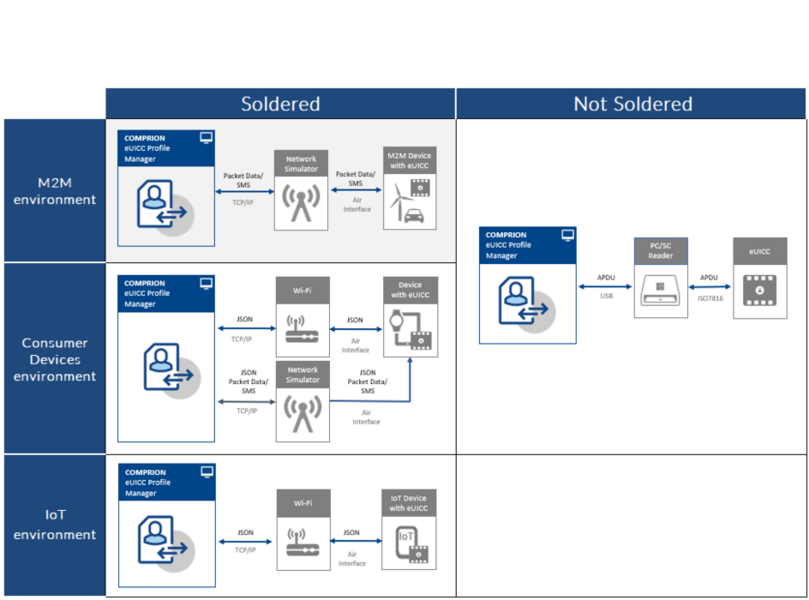
For M2M eUICCs that are already soldered into a device, a connection via a simulated (or real) cellular network needs to be established. Network simulators of different manufacturers can also be applied. This setup fits for Remote File and Application Management.

For consumer devices eUICCs that are already soldered into a device, an IP connection via a Wifi network or via a simulated (or real) mobile network needs to be established. A Wifi router or network simulator can be applied.

For IoT eUICCs that are already soldered into a device, an IP connection via an IP network needs to be established. For example, a Wifi router can be applied.

For a not soldered (e)UICC, you are able to simply connect the card via a PC/SC card reader independent from the (e)UICC technology. This option is not yet available in IoT environment.


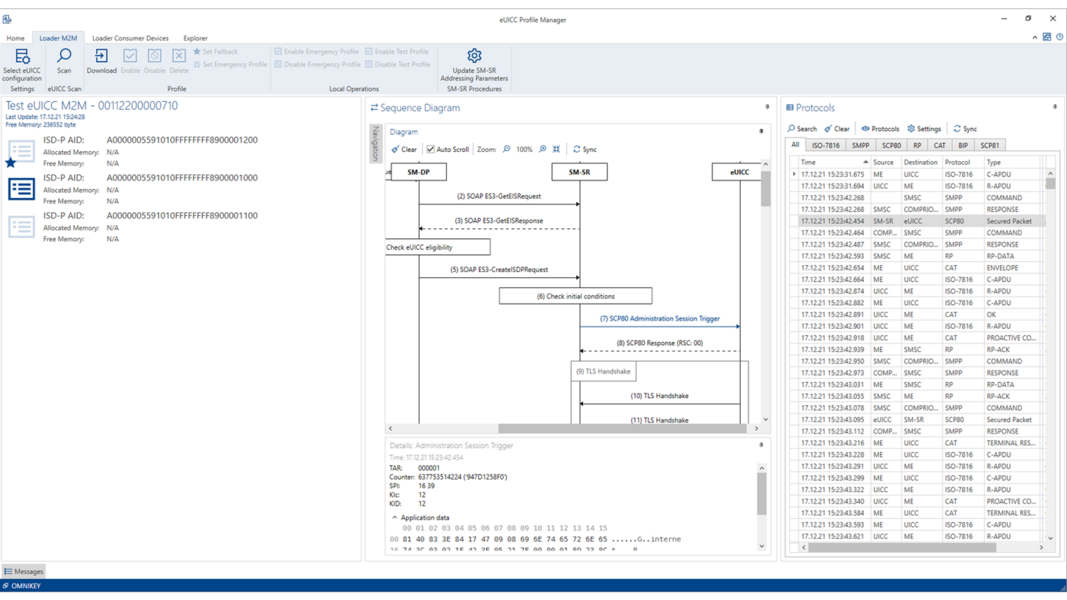
Screenshot of the eUICC Profile Manager supporting the Remote SIM Provisioning of M2M devices

Remote SIM Provisioning in M2M environment
eUICC Profile Manager's Loader M2M component supports of Remote SIM Provisioning functionality according to GSMA SGP.02 v3.2 and v4.2.
Easily download, enable, disable and delete profile defined according to Trusted Connectivity Alliance eUICC Profile Package: Interoperable Format Technical Specification, Version 2.x and 3.x.

Configuration of the SM-DP and SM-SR simulations allows the operation of different test eUICCs. Selecting the ES5 transport protocol (SCP80-SMS and SCP81-HTTP) extends the test possibilities.


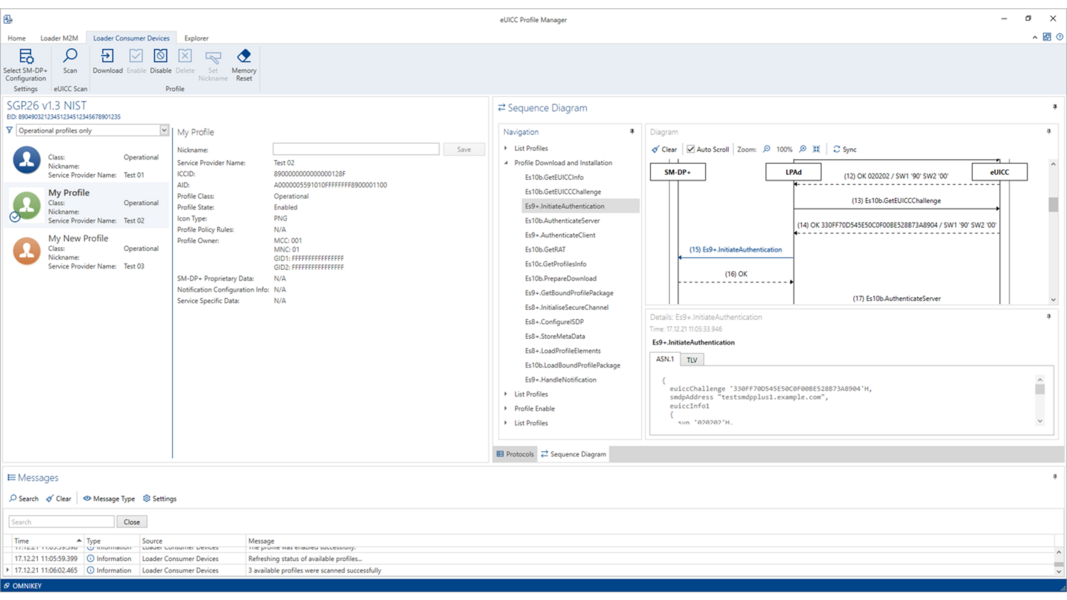
Screenshot of the eUICC Profile Manager supporting the Remote SIM Provisioning of consumer devices

Remote SIM Provisioning in consumer device environment

eUICC Profile Manager supports the Remote SIM Provisioning functionality according to GSMA SGP.22 v2 and SGP.22 v3 (via a PC/SC card reader). The configuration of the SM-DP+ simulation allows the operation of different test eUICCs and prepares a profile defined according to Trusted Connectivity Alliance eUICC Profile Package: Interoperable Format Technical Specification, version 2.x and 3.x defined profile for download.

A comprehensive visualisation of the communication flow allows you to check all details of the communication between the units involved (SM-DP+, LPA and eUICC).


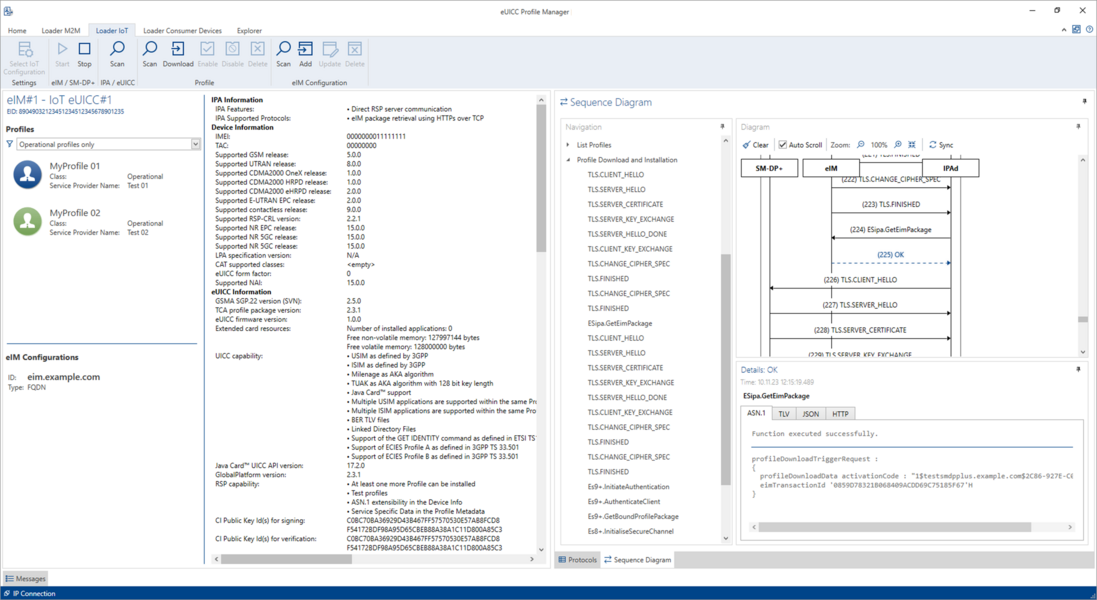
Remote SIM Provisioning in IoT environment

eUICC Profile Manager supports the Remote SIM Provisioning functionality according to GSMA SGP.32 v1.0. The configuration of the SM-DP+ simulation and eIM (eSIM IoT Remote Manager) allows the operation of different test eUICCs and prepares a profile defined according to Trusted Connectivity Alliance eUICC Profile Package: Interoperable Format Technical Specification, version 2.x and 3.x profile for download.

A comprehensive visualisation of the communication flow allows you to check all details of the communication between the units involved (SM-DP+, eIM, IPA and eUICC).


Screenshot showing the Remote SIM Provisioning of eUICC Profile Manager in an IoT environment

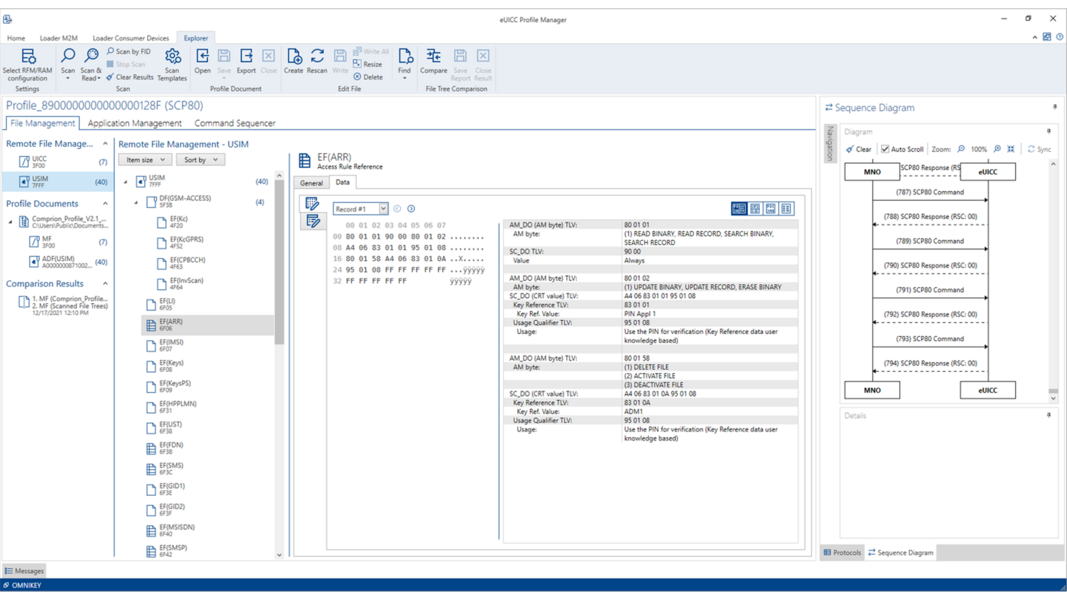
Remote file management

Scan templates allow you to detect all files located below the available applications (e.g. UICC, USIM, CSIM, ISIM and PKCS#15). The resulting file system view allows you to easily navigate between files and to update their contents remotely. Deleting existing files and creating new ones is also possible.

The compare function allows you to compare different scanned file systems and file systems defined in the interoperable Trusted Connectivity Alliance (TCA) profile package format or SIM Profile Markup Language (UXP). A report summarises the results.


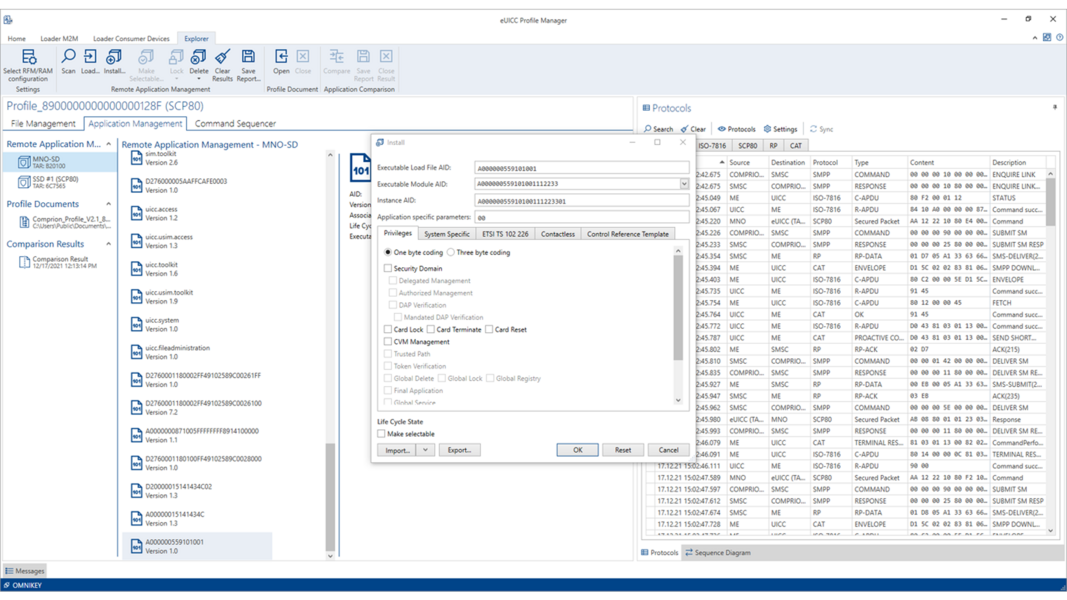
Screenshot of the Explorer feature of the eUICC Profile Manager, that allows over-the-air application management operations

Remote application management

The Explorer component allows over-the-air application management operations.Remote scanning for loaded/installed packages/applications with predefined GolbalPlatform defined
commands is an easy task as well as the loading of packages and installation of applications.

Remote access to the (e)UICC is using the transport protocols SCP80-SMS and SCP81-HTTP.


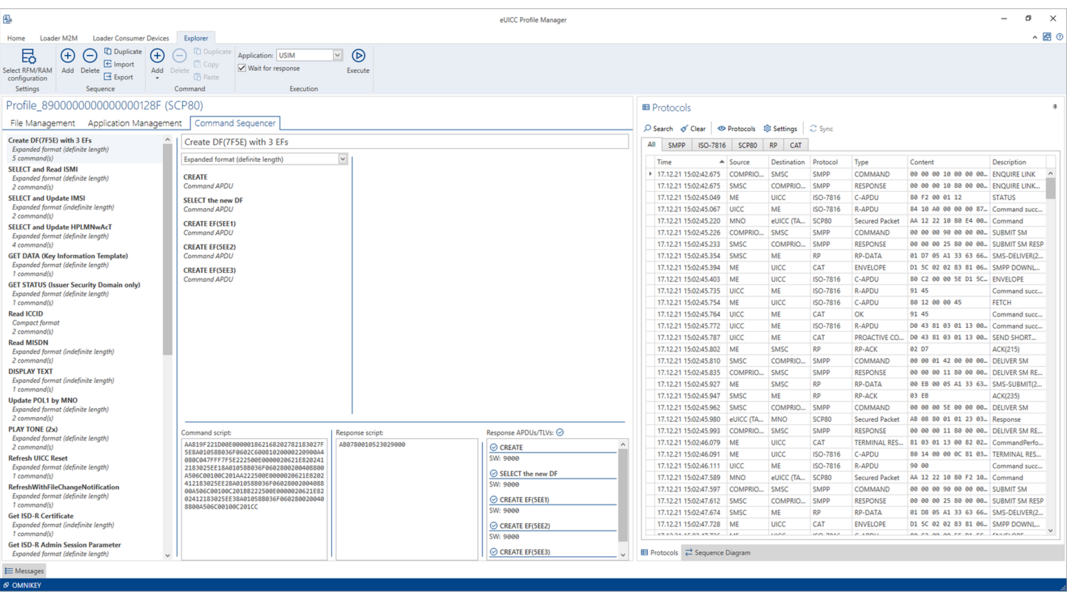
Screenshot of the eUICC Profile Manager Command Sequencer feature, that allows users to create own command sequences and use predefined templates

Command Sequencer

Want to create your own command sequence? The Command Sequencer is the right tool. It complements the remote access options and gives you complete freedom to define the commands to be sent to a target application on the (e)UICC.
Predefined templates consisting of Command APDUs (ETSI TS 102 221, ETSI TS 102 222, Global Platform Card Specification), Immediate Action TLVs, Error Action TLVs and Script Chaining TLVs support the definition of the command sequences.

Compact Remote Application data format as well as Expanded Remote Application data format (definite and and indefinite length encoding) is supported.


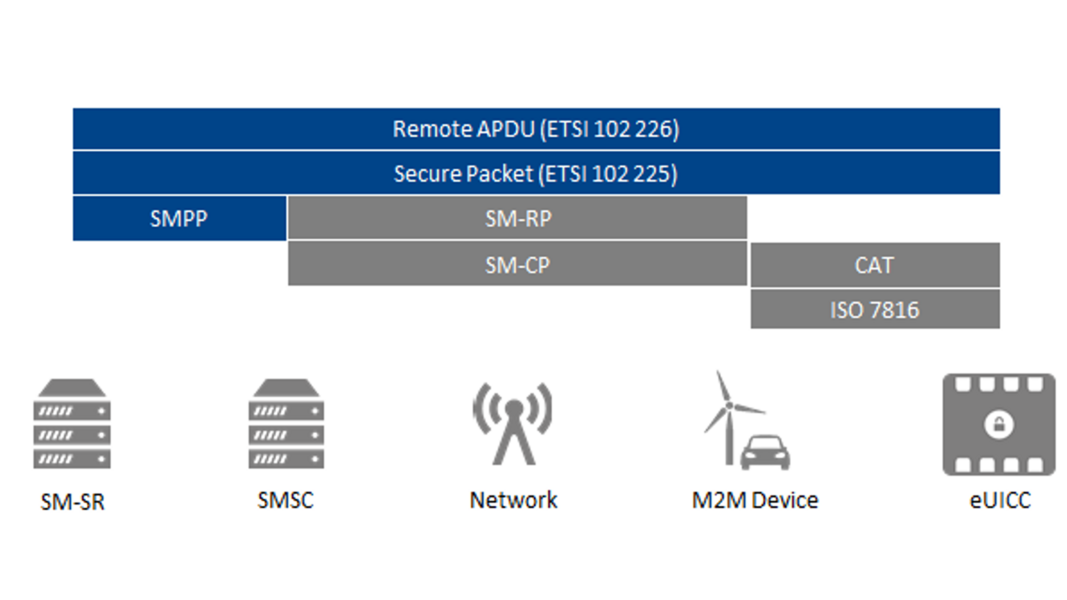
Diagram illustrating various entities involved in Remote SIM Provisioning (RSP) and the interaction between these entities through different secure channel protocols used for communication and provisioning.

Manipulation feature

If you want to test how the eUICC/UICC reacts to communication errors or unusual system behaviour, you can manipulate the default behaviour of the Remote SIM Provisioning or Remote Management procedures.
To test the behaviour of the eUICC or UICC, it is most useful to perform manipulations on the different layers of the ES5 interface (communication of SM-SR with the eUICC) or the ES6 interface (communication of Operator with eUICC/UICC).

The secure channel protocols involved are SCP80 and SCP81.


Would you like to discuss profile management in the context of your specific environment, or see the tool in action? Feel free to reach out to Marcus Dormann at mdormanns(at)comprion.com.

Contact us!

If you cannot find what you are looking for, leave us a note and we will get back to you as soon as possible.