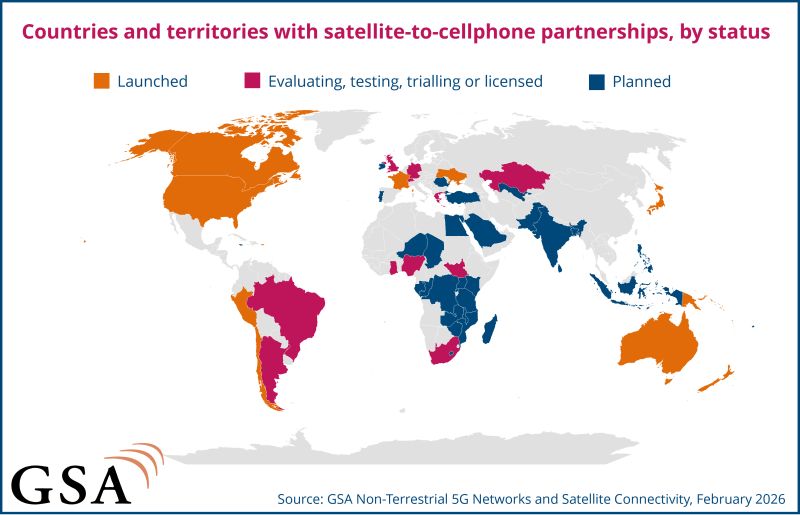
The GSA 5G NTN report, released in February 2026, identifies 225 operator-satellite partnerships across 88 countries, illustrating that satellite-to-cellphone connectivity is becoming a commercial reality: 16 partnerships have already launched services, 25 are in trials, and 53 are in the planning stage.
Future Opportunities for NTN
The integration of NTN raises important questions about the future use of mobile services. First, it is necessary to consider which regions should continue to be covered by terrestrial networks and where supplementation through NTN would make sense. It is also important to determine whether NTN should serve merely as an emergency backup (e.g., text message only) or whether it can function as a full replacement for a terrestrial network, supporting higher-bandwidth voice and data services as well.
These questions apply to both consumer devices and IoT applications:
Consumer (service is referred to as NR-NTN):
- Emergency communication backup in areas without terrestrial coverage, versus
- Full substitute for terrestrial mobile network in certain (growing?) areas (business case driven)
IoT (service is referred to as NB-NTN):
- Enabling IoT use cases that were previously not feasible (e.g., pipeline monitoring in very remote areas)
- As many IoT use cases rely on narrowband communication, a near 1:1 substitute for terrestrial connectivity is often sufficient. Also, IoT modules would benefit from only having one radio technology to be included and not the combination of multiple technologies (cost, complexity, battery-efficiency).
Business Models: Who Will Provide the Services?
There are currently three distinct business models for who will deliver and manage NTN services in the future:
- Mobile Network Operators (MNOs) as the primary providers: Extending coverage through partnerships with NTN providers operating in the background.
- Device manufacturers as specialized service providers: Collaborating with NTN providers to offer exclusive service packages on their devices.
- NTN providers as independent communication service providers: Delivering services directly to consumers or IoT customers.
Since this is still an emerging area experiencing rapid development, the ultimate outcome is uncertain. However, the first model seems to be gaining strong momentum right now.
Ensuring Interoperability and Effective Roaming
As NTN becomes increasingly economically relevant, the need to ensure the quality and functionality of these services also grows:
- Interoperability between devices and non-terrestrial networks
- Roaming between different network types, aligned with the MNOs and NTN providers’ business and partnership models
The relevant testing scope also covers COMPRION’s product areas, such as USIM/USAT mobile device conformance testing. A subset of test cases from the respective 3GPP TS 31.121/TS 31.124 test specifications has been identified as relevant for NTN device certification.
Global Certification Forum (GCF)—which develops and oversees certification programs for mobile devices (smartphones, IoT modules, etc.) to ensure compliance with 2G, 3G, 4G, 5G, and now NTN-specific standards—has created new Work Items for NB-NTN USIM/SAT testing (WI-346 and WI-347). NR-NTN USIM/USAT testing is expected to be addressed soon.
The North American certification program PTCRB has also started verifying the protocol and RF aspects of NTN but not yet addressed USIM/USAT functionality for NTN devices; however, we expect this to change soon.
In addition to mobile device conformance testing, which serves as a baseline, we expect that in particular MNOs and NTN providers will also conduct end-to-end testing to ensure proper interoperability of their services and the correct functioning of roaming scenarios. This is particularly important, because:
- Service performance and quality (bandwidth and latency) may differ more between an MNO and an NTN network interconnected in a roaming scenario than between two MNO networks
- The difference in production costs between NTN and MNO networks remains significant.
Conclusion: A Dynamic Growth Area
Non-Terrestrial Networks are more than just a niche concept. They provide a new dimension of network coverage, enable IoT applications in previously inaccessible regions, and offer potential alternative business models for mobile operators. Companies that invest early in integrating NTN could gain significant competitive advantages—provided that interoperability and service quality are consistently tested and ensured.
Interested in learning more?
We have created a video on this topic that provides a high-level overview of Non-Terrestrial Networks, how they work, and why they are becoming increasingly important.