eSIM Architectures at the 10,000-Foot Level: What Is the Difference Between a Consumer Device LPA and an IoT Device IPA?
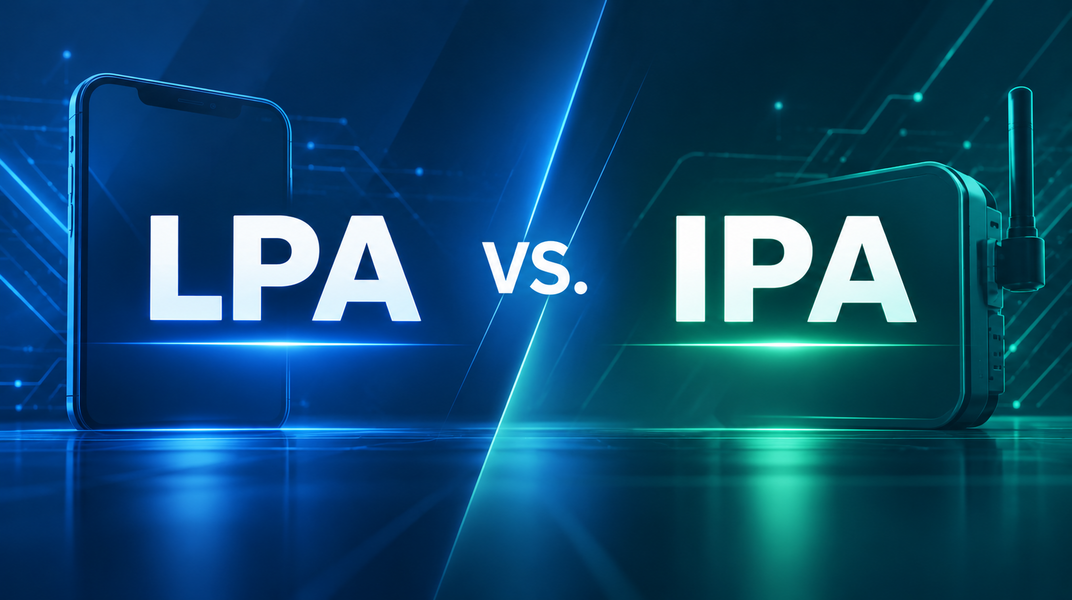
Understanding the different GSMA-standardized eSIM architectures also means understanding the commonalities and differences between them. Let’s discuss how the LPA (Local Profile Assistant) element within a consumer device eSIM architecture (SGP.22) and the IPA (IoT Profile Assistant) element within an IoT device eSIM architecture (SGP.32) relate to each other – or not.
Both components are “Profile Assistants”. They facilitate the life cycle management of eSIM profiles on the device: loading a profile, enabling, disabling, and deleting it. At a high level, this is the same for both architectures. At a more detailed level, there are differences, e.g.:
LPAs can manage “Multiple Enabled Profiles”.
IPAs can trigger the fallback to a previously enabled profile if the new one does not result in connectivity.
Conceptually, both components have the same role. However, they differ in the way they are controlled.
LPA
Control is handled on the device. It is mainly the user who triggers or approves profile life cycle activities via the user interface. However, there is also the option of having an app on the smartphone do this – if the app has the respective privileges that match the profile.
IPA
As this is about IoT devices, which are generally managed remotely and do not come with an on-site user or a user interface, the IoT eSIM architecture defines another component, the eIM, which covers this role – not just for a single device, but for an entire fleet of devices. The default deployment of an eIM is in the cloud, where it is probably integrated with the mobile device management platforms of an enterprise. However, there is also the option of deploying the eIM on the device alongside the IPA and integrating the IPA via software APIs with business logic running on the device. In particular, if you have this deployment in mind, you will recognize the similarity between an LPA and the combination of an IPA and an eIM.
Interested in learning more?
We have created a short explainer video on this topic that provides a high-level overview of the differences between the IPA and LPA:
Please note: As soon as you watch the video, information about it is transmitted to YouTube. If the video isn't visible, it may be due to restrictive browser or cookie settings. Learn more about YouTube's data usage read more