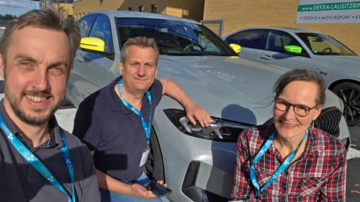
CCC Digital Key™ End-to-End Plugfest Lausitzring 2026 Interview – Dr. Marcus Dormanns (COMPRION) in conversation with Marco Steger (Huf)
This is the transcribed version of the interview recorded at the CCC Plugfest #18 at Lausitzring.
Marcus Dormanns (COMPRION): Hello! I’m Marcus Dormanns from COMPRION. I’m in charge of product management at COMPRION. We have the pleasure to be here at the CCC Plugfest hosted by Dekra – maybe you can even see the Lausitzring in the background. With me is a real expert on the CCC Digital Key: Marco Steger from Huf. Marco, would you like to introduce yourself briefly?
Marco Steger (Huf): Sure – glad to be here. Wonderful location for the CCC Plugfest. My team and I really enjoy being here, and I’m looking forward to the interview. At Huf, our responsibility is to bring our full system that we supply to customers: an NFC door handle, but also the CCC “brain,” ultra-wideband, and BLE satellites. We’re here to ensure our tech is actually working – and working in compliance with the CCC.
Marcus: And you're chairing this security certification group. So you're a real expert of CCC.
Marco: Haha. There are other experts also, but yeah, I know the standard. I love being part of the CCC. It's a great community to work with, and I think we all share that feeling. For me personally, my day-to-day job is all about building CCC-enabled systems. Being part of this community also means helping to drive the standard forward, making sure it's secure – which I think is absolutely essential – and ensuring that everything works as intended.
Marcus: So we’re both here at the Plugfest – not for the first time. I’ve seen you a number of times already. You keep coming, so there’s obviously value for Huf in being here. What do you see as most valuable about the Plugfest?
Marco: For me, the Plugfest is a great opportunity to get in touch with phone manufacturers and work on problems directly – improving the system. The complexity of the systems we build will always allow for improvements. That can mean fixing bugs in early development – and right now we’re testing the latest tech, Release 4, so of course there are things to fix. But even with an established system we bring on the road very soon – meaning Release 3 – there are always things to improve.
Furthermore, with more adoption and more CCC-capable phones, we have to ensure that things work not only today or tomorrow, but also in a few years for end users. What I see here is that we can build on today's phones – and hopefully tomorrow's phones, if they support it in the right way. At the same time, we need to help the CCC establish a certification program. Personally, I believe that's essential to ensure interoperability and to make sure these solutions continue to work reliably in the future.
But it’s not only certification – it’s also the tooling. Tools that help ensure, on protocol level and on various levels, that things work. That’s where you come into the game.
Marcus: We provide tools, and we’re also learning a lot here. When our customers use our tools and give feedback, it helps us improve them and make testing even more solid.
Marco: Absolutely. I can see your latest improvements first-hand – it’s clear the feedback loop is working. We really appreciate the effort you put into bringing the tool here, setting it up, and maintaining it. It’s a fundamental part of what we do here.
Marcus: As a vendor of test tools – and in particular tools that validate all the details of the complex CCC protocol at the protocol level – we're interested in understanding the value you see in protocol-level testing. Why is it important to go beyond manual functional testing and also use tool-based testing at the protocol level? How do you see this?
Marco: I’ll circle back to future interoperability. We can come here and verify that, with one of our systems and a system from a device or smartphone manufacturer, everything works together correctly. But we have to take another step. This is where the tool comes in: if both sides are compliant to the standard on protocol level – in our case on APDU level – then the chances that things will actually work in the field in two years are higher.
And you can’t really do that without proper support by the tool. Otherwise: how do you reproduce it? How do you ensure everyone executes the tests the same way? And this is where I think we need the kind of tool that you've brought to the CCC.
Marcus: And that brings us to the next step, which is probably certification. There is a certification program defined and run by the CCC community. There’s always a debate: what is the value of certification? Is it necessary? Or can we move ahead without it – since it adds complexity to go through certification. How do you see that for your business at Huf?
Marco: First of all, we appreciate the chance given by the CCC to get certified through Plugfest participation. This is actually why we’re here – and why we really need your tool here with us. We use it every day to reach that goal.
And on top of that, I think – and I know this is part of the discussion – that if we focus only on the top level, it becomes difficult to ensure compatibility for future devices. As I mentioned, the protocol is complex, and I'll say it again. There is complexity in Release 4, and it's only increasing. There are so many moving parts. I think it's good that, for example, with NFC, we have the possibility to really break things down and say: at this level, based on NFC, we act exactly as defined in our test catalog and in our specification. As the ecosystem grows, I don't see a way around this. For me, there is a clear path in terms of where I would like to go.
Marcus: You're coming from the automotive industry, which means you're used to putting technology into a product – the vehicle – that remains in use for ten years or more. This means your digital key solution will be faced with smartphones coming to market ten years from now, and today we have no idea what those phones will look like or what will be implemented in them. That’s a challenge.
Marco: It is a challenge. There’s also concern on the customer side. With slow-moving automotive development cycles, from the time we see the first RFI until we bring a system on the road – and then the ten or twelve years a car is on the road – a huge amount of devices will go through that cycle.
I remember my first “phone as a key” project: at the beginning, we defined a target device list. Those devices are now outdated – but they’re still out there. People switch phones every year. That’s the reality in automotive.
Marcus: So, you and Huf have dedicated development processes, testing processes, and defined requirements. You have an established way of working. How do you deal with tools in this environment, and what challenges do you face?
Marco: We love our processes in automotive – they’re important. Building a car is complex, and process is a guiding principle. Bringing in these tools now — and the entire kind of testing we do here at Plugfest – is an additional task on top of what we’re used to. We build systems requirements-based, we have our frameworks, and they ensure quality. But integrating tools and making sure things work not just for one phone – not just one green test – but green and green and green for many devices, that’s a new mindset that we struggled to introduce.
At the same time, we see it’s important. Customers ask us for automated testing. They ask: how do you ensure stability and maturity in your system? And this is not just about saying, "I have 10,000 requirements and 12,000 tests to prove it." They want to see other opportunities and other ways of ensuring this as well. That’s where test tooling like yours comes in. So the question is: how can you help us make it even easier?
Marcus: On one side, from the tool side, we’re here to get requirements from you and other colleagues in the ecosystem.
On the other hand, COMPRION has a strong background in telecommunications, and for me personally, that's interesting because we're used to dealing with interoperability challenges. We operate in a mobile ecosystem where 500 new phones come to market every year, where mobile networks come from a range of different vendors, and where we need to ensure interoperability. And that's been an ongoing task for many years now. We try to bring some of the lessons learned from that industry into what’s happening in automotive.
Marco: That makes a lot of sense.
Marcus: When thinking about the Digital Key, we think about using a smartphone to open the door and start the engine – but there’s more. Huf comes from a world of vehicle access solutions for decades, originally not based on smartphones, but on key fobs and other form factors. From your perspective: how is this evolving? What are the forthcoming requirements for digital keys? How do these products, which your companies develop and which drivers use in their cars, fit into all of this? What do you think?
Marco: You're right. When I first visited the Huf headquarters in North Rhine-Westphalia, I learned that we're located, in what they call the "key area." It's known as the key area because there are many companies that have been providing physical key fobs for a very long time. So we have a lot of experience in that field.
Now, the transition from the physical key to the digital key is something we have to follow very closely because, for a long time, it has been the bread-and-butter business for us at Huf.
At the same time, it's not that the digital key will completely replace the physical key. Depending on the user group, age, or region, we still see demand for other form factors that can carry a digital key while remaining distinct from a smartphone. That's very interesting for us because our customers want a range of different options. You can't assume that every customer will be happy using only a phone as their primary access token. And even if the phone is the primary access token, there will always be use cases where people want to fall back on a traditional key fob or use a cool new form factor. Whether it's a watch or another way of proving to the car that you're the owner, these alternatives are very interesting for us. Of course, we see great value in the digital key, but we also see opportunities for many complementary products built on top of it. And, of course, we need to ensure the same level of quality for those products. That means applying similar testing approaches and making sure they work reliably as well.
Marcus: Marco, many thanks for the insights – it was really interesting. Thanks for taking the time to talk here at Lausitzring. I hope, and I think, that we'll meet again at future Plugfests. This won't be the last Plugfest, because there's still a lot of work for all of us to do, right?
Marco: Thanks for having me – I enjoyed it as well. I’m pretty sure we’ll meet again. Let’s keep this up, because I really think the ecosystem benefits from this Plugfest – and it’s a lot of fun doing these things together.
Marcus: Thanks a lot – goodbye and see you next time.
Marco: Thank you very much. See you.