May 18, 2026
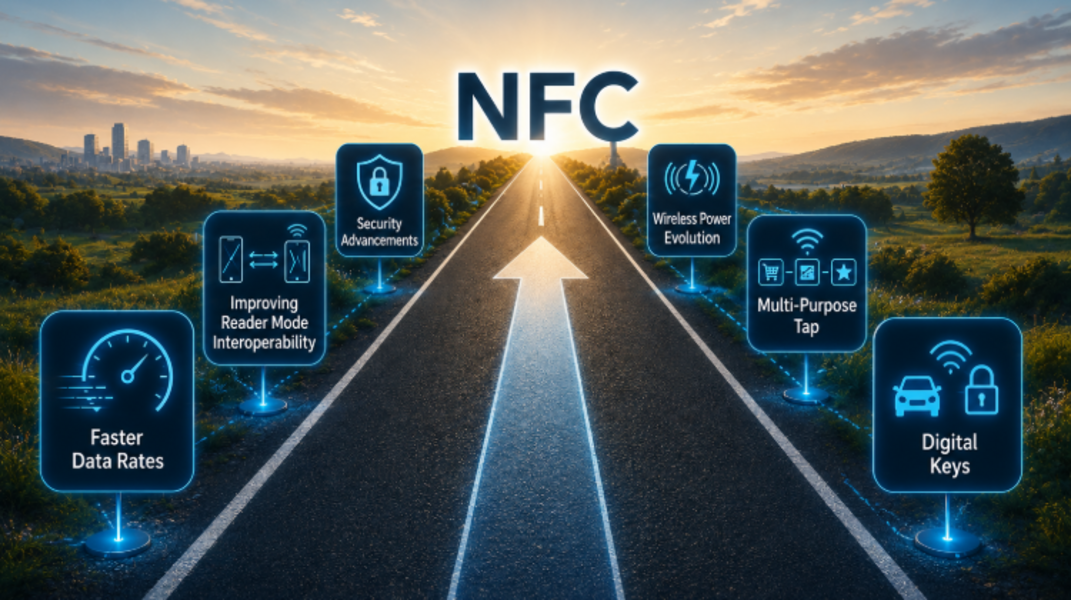
With the release of the Technology Roadmap 2026, the NFC Forum is setting clear priorities for the next stage in NFC evolution:
- Faster Data Rates
- Improving Reader Mode Interoperability
- Security Advancements
- Wireless Power Evolution
- Multi-Purpose Tap
- Digital Keys
For providers of NFC tools and test solutions – such as COMPRION – it is essential to identify potential testing implications at an early stage in order to build future-proof products. Both digital and analog testing aspects need to be considered.
Faster Data Rates
In general, this requires test hardware with sufficient performance reserves. Today, testing is typically performed at the base data rate of 106 kbps. In the future, however, data rates up to eight times higher (848 kbps) are conceivable.
This particularly affects the analog side of testing. Higher data rates imply higher frequencies, which in turn lead to changing requirements for antenna design – both on the device side and for test and reference antennas.
In addition, higher-frequency communication is more susceptible to interference. It can therefore be expected that test cases will need to be fundamentally adapted, along with their implementation in test tools.
Improving Reader Mode Interoperability
Currently, NFC Forum testing is primarily based on traditional conformance tests. This means that a single component (reader, tag, or device in card emulation mode) is tested within a reference environment. Passing these tests is important and necessary, but it only provides limited insight into behavior in end-to-end scenarios, where interoperability between two specific systems becomes the key challenge.
A wide range of factors plays a role in this context:
- Antenna form factors
- Industrial design (materials between the components or in their surrounding environment, distances, and angles)
- Usage behavior (static positions versus dynamic changes in relative positioning, speeds, and angle
- Environmental factors (humidity, temperature)
The NFC Forum is rightly planning to place greater emphasis on such end-to-end interoperability and real-world testing aspects, for example through a smartphone app. This would allow a smartphone, acting as either a reader or in card emulation mode, to represent one side of the communication in an end-to-end (E2E) scenario.
Security Advancements
Security is a fundamental part of NFC and is becoming an even stronger focus of technological development in the next generation. This involves two key aspects:
- „Post-Quantum-Cryptography“ (PQC): the use of cryptographic algorithms that remain secure even in the era of quantum computers
- Prevention of relay attacks: one approach is to define and verify very low maximum latency thresholds for end-to-end transactions in order to technically hinder or prevent such attacks
Both aspects require powerful test tools – especially for executing cryptographic algorithms and processing test data. The concrete testing requirements are currently not fully foreseeable.
However, it is certain that new functional requirements at the digital protocol level will need to be tested, as well as timing-related aspects.
At the analog level as well, requirements for NFC product components such as readers and tags will increase. These components often need to meet strict constraints in terms of cost and power consumption. Ongoing technological advancements continuously expand the available options. At the same time, achieving a sensible balance between these requirements will remain important.
Wireless Power Evolution
The current standard defines a charging power of approximately 1W. The goal is to increase this to up to 3W.
To achieve such power levels, significantly higher currents in the antenna are required in order to generate a sufficiently strong field. The exact values depend on the technical standard as well as the geometry of the antenna used. A test tool must therefore be capable of supplying these higher currents accordingly.
Multi-Purpose Tap
This is a highly useful feature in which multiple services can be triggered with a single tap, e.g., payment, loyalty card, and receipt.
From a testing perspective, this results in additional functional digital test cases. However, it does not represent a fundamental change to tools or test architectures.
Digital Keys
Looking at NFC components that have undergone NFC Forum certification over the past one to two years, it becomes clear that the digital key use case is of enormous importance for NFC.
So far, the focus has been on:
- Digital keys for vehicles, in line with the specifications of the Car Connectivity Consortium
- Access control solutions in home and enterprise environments, e.g., within the certification programs of various smartphone manufacturers
New are access control solutions based on the Connectivity Standards Alliance (CSA) Aliro specification, with the first version published only a few weeks ago.
Testing within the context of the Car Connectivity Consortium and smartphone manufacturers’ certification programs requires NFC Forum-compliant components. Additional testing is also performed within the respective ecosystems, according to their extended testing requirements.
Given the high importance of the digital key use case and new developments (Aliro), it is plausible that the NFC Forum will continue working on supporting these use cases through technical and test-related specifications (similar to how the CCC device class was previously defined). Further testing requirements are currently not yet clearly foreseeable. These may relate both to the digital/functional domain and the analog domain, especially when new device form factors or antenna designs become relevant.
Who Testing Is Especially Relevant For
Two main groups can be distinguished: manufacturers of NFC components and providers of NFC-based use cases.
Manufacturers of NFC components – such as tags and readers – must ensure that their products comply with the respective specifications. The focus here is compliance with NFC Forum specifications, which is typically verified through conformance testing. Accordingly, conformance test tools are primarily used in this area.
On the other hand, providers of NFC-based services – for example in ticketing, digital keys, or information services – rely on an already specification-compliant infrastructure. For them, the focus is not on certifying individual components, but on the reliable performance of the overall system in real-world applications. These stakeholders therefore primarily use monitoring and analysis tools to ensure that interoperability between different components remains stable under real conditions and despite various sources of interference.
Conclusion
The NFC Forum Technology Roadmap makes it clear that requirements for NFC testing are evolving across multiple dimensions simultaneously.
First, higher data rates and wireless power increase analog requirements – particularly for antennas, signal quality, and test hardware.
Second, rising interoperability requirements significantly increase the importance of end-to-end and real-world testing, going beyond traditional conformance testing.
Third, new security requirements mean that digital testing must be extended to include cryptographic methods as well as precise timing and latency analysis.
NFC testing is therefore becoming broader, more complex, and more system-oriented. Traditional isolated conformance tests remain necessary, but are increasingly no longer sufficient to reliably ensure the behavior of NFC systems in real-world applications.
As a long-standing provider of conformance test solutions and monitoring and analysis tools in the NFC space, COMPRION is evaluating early on which future testing requirements will become relevant and is actively preparing its products accordingly.
Related News
![]()
To learn more about the impact of CR15 since its launch, we spoke with NFC Forum’s Executive Director, Mike McCamon, who also shared his insights into…
Read more
![]()
We spoke with Andreas Bender of IBL-Lab GmbH to explore current challenges, certification processes, and emerging NFC trends in the automotive…
Read more