August 10, 2026
Digital access systems are undergoing a fundamental transformation. What today often consists of isolated, proprietary solutions is increasingly evolving into an interoperable ecosystem. This is exactly where Aliro comes in.
Aliro is a technical standard developed by the Connectivity Standards Alliance (CSA) for digital keys, locks, and access control systems. It addresses both consumer applications – such as front doors in smart homes – and professional use cases like access to office buildings or hotel rooms.
At its core, Aliro is about providing authorized users with secure and convenient access through a digital key. What matters is not only the functionality itself, but also how this access can work reliably and interoperably across different devices, manufacturers, and ecosystems.
How Does Aliro Work Technically — and Why Is Interoperability Important?
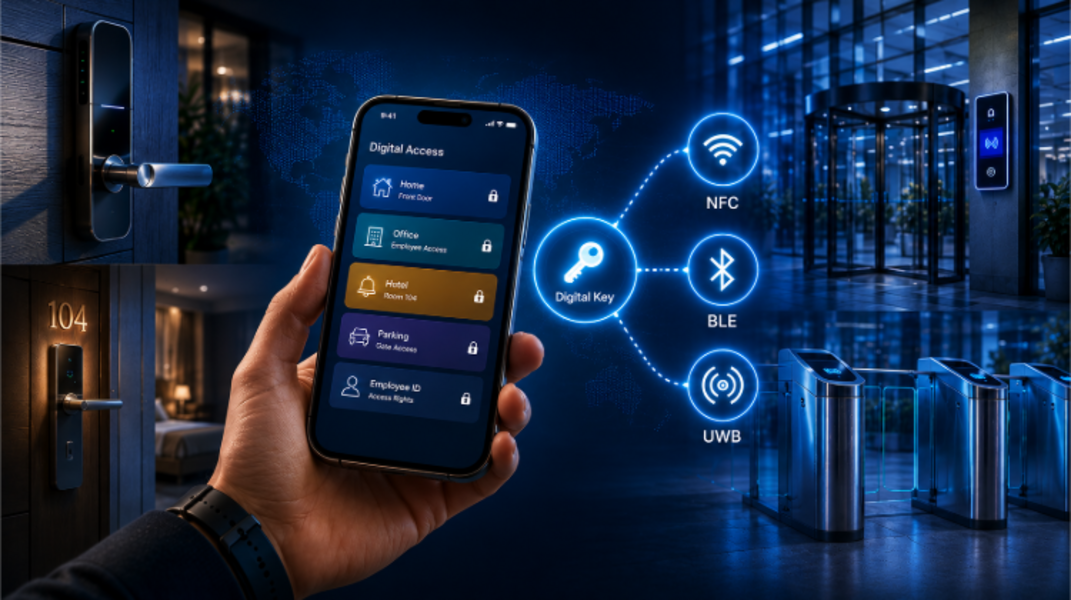
Aliro combines three wireless technologies to deliver both maximum security and an optimal user experience:
- Near Field Communication (NFC) enables contactless locking and unlocking by simply presenting the digital key close to the lock.
- Bluetooth Low Energy (BLE) enhances convenience by supporting operation over longer distances and additionally manages UWB communication.
- Ultra-Wideband (UWB) enables precise distance measurement between the key and the lock. This ensures that the digital key is actually in close proximity – an important safeguard against relay attacks and other misuse scenarios.
Previous digital access solutions often relied solely on NFC or BLE. NFC-based solutions are generally considered secure but do not support true hands-free access. Pure BLE-based solutions improve convenience but quickly reach security limitations without additional distance measurement capabilities. Only the combination with UWB creates the foundation for both strong security and a seamless user experience.
In addition, Aliro defines a flexible concept known as “Access Documents.” These digital credentials go far beyond simple lock/unlock use cases. For example, they can support time-limited permissions for hotel access, granular access rights, and different roles or authorization levels.
An employee, for instance, could receive access to an office building while being restricted to specific areas within the building. This flexibility opens the door for new product concepts and differentiated services.
Without a common technical standard, however, such use cases would hardly be economically viable:
- The combination and orchestration of NFC, BLE, and UWB is technologically complex.
- No product vendor wants to develop such a sophisticated technical solution entirely on its own. Proprietary approaches that only address small market segments are not economically feasible at this level of complexity.
- Users expect ONE unified solution for different digital keys – not separate systems for every application.
Interoperability is therefore not an optional feature, but a prerequisite for broad market adoption.
Comparison and Differentiation from the CCC Digital Key
Comparisons with the CCC Digital Key standard from the automotive industry are obvious: both solutions combine NFC, BLE, and UWB to enable digital access to physical objects.
In reality, however, the two standards differ significantly.
Aliro deliberately leaves out several complex topics that are essential in automotive environments and are covered by the Car Connectivity Consortium (CCC):
- Provisioning and registration of digital keys:
Aliro does not define how digital keys are issued or registered with a lock. These processes are left to individual solution providers. - Key sharing across different ecosystems:
The CCC standard addresses complex scenarios such as vehicle handovers or workshop visits, including interoperable backend communication between different smartphone vendors. Aliro currently excludes these topics. - Vehicle-specific security logic:
Automotive use cases require additional security conditions — for example, ensuring that a vehicle can only be started when the key is physically located inside the vehicle.
As a result, Aliro is significantly leaner and less complex than the CCC Digital Key standard.
It is also important to note that even where the use cases appear similar, the technical specifications are implemented entirely differently. The similarities are largely limited to the fundamental concept of digital locking and unlocking and the use of the same wireless technologies.
The Role of Wallets and Smartphone Ecosystems
In the long term, digital access solutions will have to rely on smartphone manufacturers and their wallet ecosystems.
The primary driver is user experience: users want to manage their digital keys centrally in one place – not scattered across numerous standalone apps. Wallets provide the natural platform for this.
There is also an important technical aspect: full access to NFC interfaces is often only available within the respective wallet infrastructure in many smartphone ecosystems. Anyone looking to deploy digital keys at scale must therefore consider the requirements and constraints of the major smartphone platforms.
As a result, wallet providers are becoming a central component of the future Aliro ecosystem.
CSA – Standardization and Certification
The CSA is a well-established standardization organization with a strong focus on IoT and smart home technologies. Some of the best-known CSA standards include Zigbee and Matter.
In addition to developing technical specifications, the CSA also covers product certification.
Companies participating in the Aliro initiative include:
- suppliers of NFC, BLE, and UWB chipsets or modules,
- manufacturers of locking systems and access solutions,
- and smartphone manufacturers.
Although Aliro is still in an early market phase, the first certified products and components already exist and are documented on the CSA website.
What Specific Aliro Test Solutions Does COMPRION Offer?
As technical complexity increases, the importance of powerful testing and analysis tools grows as well. The interaction between NFC, BLE, and UWB – combined with interoperability requirements across devices and platforms – makes advanced analysis and debugging capabilities indispensable.
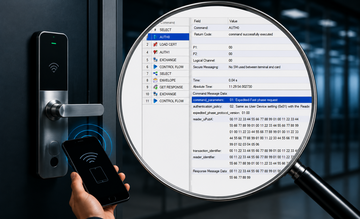
As a first step, we have therefore enhanced our NFC sniffing tools – TraceCase, CL Verify A, and the associated software solutions – with Aliro-specific functionality. Specifically, this includes decoding and analyzing NFC protocols used in Aliro transactions.
TraceCase and CL Verify A enable monitoring of NFC communication on both the analog and digital layers while providing data for analysis and debugging purposes.
The Aliro-specific decoding of binary data significantly improves efficiency and effectiveness during development and troubleshooting. For COMPRION, this is the logical evolution of TraceCase and CL Verify A, which are already successfully used in access-related CCC environments as well as smartphone manufacturer certification programs with comparable functionality.
Outlook: From Digital Keys to Comprehensive Access Platforms
Unlocking and locking doors is only the beginning.
With its flexible “Access Documents” concept, Aliro creates the foundation for far broader and more diverse use cases. Possible future applications include:
- transferring additional authorization information,
- role-based access concepts,
- and service-related permissions within hotels, office buildings, or shared spaces.
For example, a hotel credential could eventually not only unlock a guest room door, but also define whether the guest has access to the minibar, fitness center, or in-room safe.
Sharing digital keys will also become increasingly important over time. Physical keys are routinely shared today — and users expect the same convenience in the digital world.
This is one area that Aliro has intentionally excluded so far. In contrast, the CCC specification already addresses these scenarios. For such features to become practical, digital keys must be shareable across wallet ecosystems from different smartphone providers. Beyond technical interfaces, this will also require close cooperation between platform vendors and wallet operators.
Whether and how Aliro will address these topics in the future is likely to play a decisive role in the long-term market development of the standard.
Related News
![]()
With the new Aliro Translator, COMPRION enables efficient monitoring and visualization of Aliro and NFC communication for secure mobile access systems…
Read more
![]()
COMPRION releases updated CCC Digital Key BLE Test Benches with latest test specifications, automated HCI log handling, and enhanced interoperability…
Read more
![]()
The CCC DK NFC E2E IOP Test Bench v1.1 supports certification testing of NFC-based Digital Key solutions in compliance with CCC specification v3.1.5
Read more