This is the transcribed version of the interview recorded between Dr. Marcus Dormanns (COMPRION) and Manfred Jantscher (CISC).
Marcus Dormanns (COMPRION): Hello, everybody. My name is Marcus Dormanns. I'm with COMPRION. I'm responsible for product management and business development. And today with me is Manfred Jantscher from CISC. We want to talk about NFC testing, contactless testing. Maybe first of all, Manfred, introduce yourself a little bit, and of course your company.
Manfred Jantscher (CISC): Hello, my name is Manfred Jantscher. I'm working for CISC Semiconductor, which has its headquarters in Klagenfurt. Personally, I'm working in Graz in our development office. I started working for CISC in 2004 as a student, at that time with my bachelor thesis. And during that time, until now, I touched multiple topics, starting with UHF RFID, chip verification, software development, and of course also NFC.
CISC is a company that provides services and products for the semiconductor industry. So we have multiple units that do different things. One of the bigger units is the unit that provides test devices for UHF, NFC and meanwhile also Bluetooth communication platforms. It's the explorer line that is led by my colleague. I personally am now responsible for the competence unit: communication systems and platforms, where we mainly deal with software development. And I'm also leading the NFC Interoperability Test Lab that we will be discussing today.
Marcus: Manfred, when I looked at your company, for example, at your website, I recognized that you are addressing a broad variety of testing use cases. And, interestingly, this goes beyond conformance testing, for example, NFC Forum conformance testing or conformance testing from other organizations. So, obviously, there is a lot of testing beyond just conformance testing. Many people think, conformance testing, that's it. If I've done this, I'm done. But that's not the case. Maybe, could you explain a little bit what other use cases you experience for contactless devices, which go beyond just conformance testing?
Manfred: Maybe I should start by telling you how the NFC Interoperability Test Lab was founded. We were approached by NXP in approximately 2012, and they wanted to have a lab that is independent from official compliance testing labs, where they could test applications, at that time mainly payment applications, in a way that makes sure that the chips they create work as well as possible for the end user.
The aim of their request was to have a lab – you know, NXP is nearby in Gratkorn – where they could go and test their latest NFC chips. So we started to set up that lab. Together with NXP, we started with a single plate of payment terminals, defined the test procedures and also the reporting and the required debugging possibilities.
All of that has led to a lab where we now have lots of qualified equipment, like 65 EMVCo-approved payment terminals, 35 or more than 35 mobile phones, and lots of different contactless cards that can be used in order to run interoperability tests, and where the customer has the possibility to join the lab and the activities in order to do the debugging.
Marcus: One test use case is really interoperability testing besides compliance or conformance testing of an individual device or component. So what is it that makes people go for interoperability testing, or what are the pitfalls these companies may see if they just rely on conformance testing and do not take care of interoperability testing, from your experience?
Manfred: The problem with conformance testing is that conformance testing makes sure that everything is according to the conformance spec, which does not mean that if you have a specific device, like a contactless card, it works equally well with all the different reader devices out there.
And this is where we step in. We provide a good amount of contactless payment terminals, for example, in order to test or provide the possibility to test new chips that are later built into cards or into mobile devices, and make sure that they work as well as possible.
What we figure out is that there are always cases where, although the products both conform to the required specifications, they do not work properly because of various reasons. And this is the reason why we have that interoperability lab and why we also offer various possibilities to look into the communication.
The main focus is clearly the analog interface, which is tested. But we are using the actual application to go through protocols and see what happens, right. So, for example, we use contactless payments because at the time when we started, this was the main application. And it is still – it takes quite long and, especially with cards, contactless payments require a cryptographic step at the end, which is quite energy-consuming. And especially with cards, we sometimes see issues with some devices. These are the issues that need to be solved because of the limited power which is available, for example, in that case.
Marcus: I think that's a good finding. And also that is consistent with our experience. So having two devices which are both conformance-tested means that probably they can somehow interact with each other. But whether this happens with good performance, with a good user experience, that is a different thing and is not guaranteed by just doing the conformance testing.
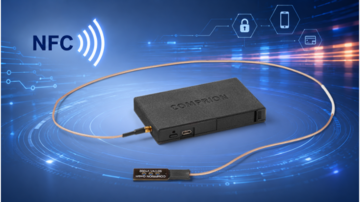
In your Interoperability Test Lab, you're also using our TraceCase, the product from COMPRION, for NFC tracing. Of course, I'm very interested to understand what it is you're doing with the TraceCase in your test use cases.
Manfred: You know, if you do interoperability tests, you find issues, and you need to understand where these issues come from. And for that reason, we always had some kind of sniffer in our lab. We started with the CISC NFC Explorer, which is mainly a tool to look into the analog communication, not providing much protocol debugging.
Later we bought the MP300 from Micropross, which is a rather complicated device to trace both analog signals and also the digital communication and the protocol. Not only because this device went end of life, but also due to the requirement to have a tool that provides a quick understanding of what happens in the field if something does not work properly, we looked around and figured that the COMPRION TraceCase would be a good tool for us, because it's very easy to use.
You can simply take it, hold it into the field. We have connected it to a smartphone and you can get a live view of the protocol, essentially.
That helps a lot, at least in the first step of debugging. This makes us very efficient in our activity to find the underlying issue and to provide the information that is required by the chip vendors in order to adjust their chips so that they work properly.
Marcus: That, of course, is great to hear for us, that the intention of this tool is really fulfilling its promise in your use cases and in your labs. So one more topic, which you told me previously already, is that you're also using the TraceCase to measure field strength and to draw some conclusions from this. Maybe you can explain a little bit about this?
Manfred: We have customers who ask us to measure field strength during the transaction, so it could be unloaded or loaded with the card. And we have devices that can do that very accurately. And with the TraceCase, we now have a device that supports us with that measurement, especially if you need a quick indication of the field strength.
You take the TraceCase, your application, and see immediately the field strength that is available in both directions. From reader to card and also the reply field strength. That is very helpful.
Together with the Toolbox and the API that TraceCase provides, we have already had projects where we integrated the TraceCase into our automatic test setup in order to capture field strength as well.
Marcus: Very interesting. So maybe let's move a little bit on to the future of testing and NFC testing. NFC Forum recently published its technology roadmap and there are a number of topics on it. And what, of course, is of interest to me is your perspective on what topics are, let's say, more relevant, but maybe also more challenging for testing and for the user, of course.
Manfred: We have talked about contactless payment until now only. But we, of course, do other tests as well. We got quite active in the NFC Forum activities, starting with the ordinary in-depth data exchange. Like what we do recently is the digital product passport.
mPOS is something that gets more and more important. Instead of a contactless payment terminal, you have a smartphone running card-reading software that can do payment transactions. And then we get also into more complicated areas like digital key access control.
What has to be mentioned as well is wireless charging, where we are quite experienced because we worked with the NFC Forum to create the first version of the wireless charging specification.
And what also comes up is multipurpose tap, where we think – we haven't done any multipurpose tap tests yet – but we are quite sure that sooner or later we will get requests to test that kind of technology.
Marcus: That's, I think, a very interesting and relevant use case. It's on the horizon of NFC Forum. It's not yet there. But, yeah, that's also something you regard as relevant going forward, right?
Manfred: Yes, absolutely. And this is also something that we try to keep informed about. This is also one of the reasons why we are members of the NFC Forum, in order to get the information about where the industry is going. We try to keep informed about what's coming up.
And also we try to provide the necessary tools in order to run interoperability tests that may even be for applications that are not yet on the market, right. We are quite close to the market because if we test a product, it is, yeah, quite far into the process of market introduction. But we need to be prepared for such tests as well.
Marcus: Absolutely. Another topic on the NFC roadmap is higher bandwidth. Maybe, can you elaborate a little bit on what the need for higher bandwidth is, but also what the implications are for testing?
Manfred: Yes, that's right. So as you know, high bandwidth, 848 kbps, has been around for a long time already. But the applications that we have currently in our tests all work at quite low data rates.
We need to be prepared to test with higher bandwidth because of applications like the passport, contactless passport, where lots of data need to be transferred. We also need to have equipment or debugging equipment that allows us to look into that kind of communication and understand potential issues if they appear.
Marcus: What I learned from you in a previous discussion we had was that you said, look, if it's about more data which is transmitted, it simply takes longer to transmit the data. This means that it becomes difficult to assume that the card or the phone or whatever this is remains in a constant position relative to the reader.
The longer it takes to transfer the data, the higher the risk is that the card or the phone moves around a little bit, and that, of course, impacts the quality, the user experience at the very end. Higher bandwidth, of course, can help to shorten the time frame you need to keep the phone in the field.
But would it mean that maybe in the future we need to think about test cases where the card is not stable in the field, but maybe it's moving around, it's moving in, it's moving out or so? Would this make sense?
Manfred: Sometimes we do such kinds of test cases already because also with contactless transactions, you cannot be sure that the card is in a fixed place. But yes, generally I agree.
One of the things you can do in order to make the transaction stable is to increase the data rate. If there's lots of data that need to be transferred, increasing the data rate certainly helps to finalize the transaction quickly and to have the best possible user experience, because nobody wants to hold their card for 1 to 3 seconds on a reader.
Marcus: This is one more example, I think, where the conclusion is that just having two conformance-tested devices doesn't guarantee that you have a successful transaction with a great user experience, because of these timing and data volume aspects.
One more topic on the roadmap, which is discussed broadly, of course, is cryptography and in particular post-quantum crypto. Everybody is thinking about this to make sure that everything remains confidential also in the future. But this, of course, is also posing some requirements on NFC technology and the devices in particular. How do you see this, Manfred?
Manfred: Especially for cards, which in my opinion will remain. We are not all going to use our watch or mobile phone. There are lots of people who like to use their cards. This imposes quite high power requirements.
What we saw in the past is that with payment transactions, if you get into the stage where the card does the cryptographic calculations, we see issues in the stability of the communication. Communication may be interrupted if the card starts to calculate cryptographic checks, for example.
This is where TraceCase can quickly help us to understand that the issue that we are seeing is coming at that step.
Marcus: This challenge may then grow in the future with more challenging crypto algorithms which require more processing power, which require more energy to be calculated, so that may become even harder in the future, right?
Manfred: Yes. I mean, vendors meanwhile have learned that it's necessary to provide sufficient power for the cryptographic requirements, but they need to be prepared that even more power is required when we go into post-quantum cryptographic procedures.
Marcus: A very relevant topic, I think. Thanks a lot, Manfred, for all these insights and for the very interesting discussion. It was very insightful for me. And I think also for many people watching this video. So, thanks a lot. And yeah, bye, bye and have a good time in Austria.
Manfred: Thank you, Marcus. And thanks also for providing us with the TraceCase, which we are very happy to use in our lab in order to do efficient debugging and analysis. Thanks a lot for that interview. Good wishes to Germany.