April 28, 2026
MEP (Multiple Enabled Profiles) is far more than just a technical extension of eSIM – it represents a significant step toward true flexibility in mobile connectivity.
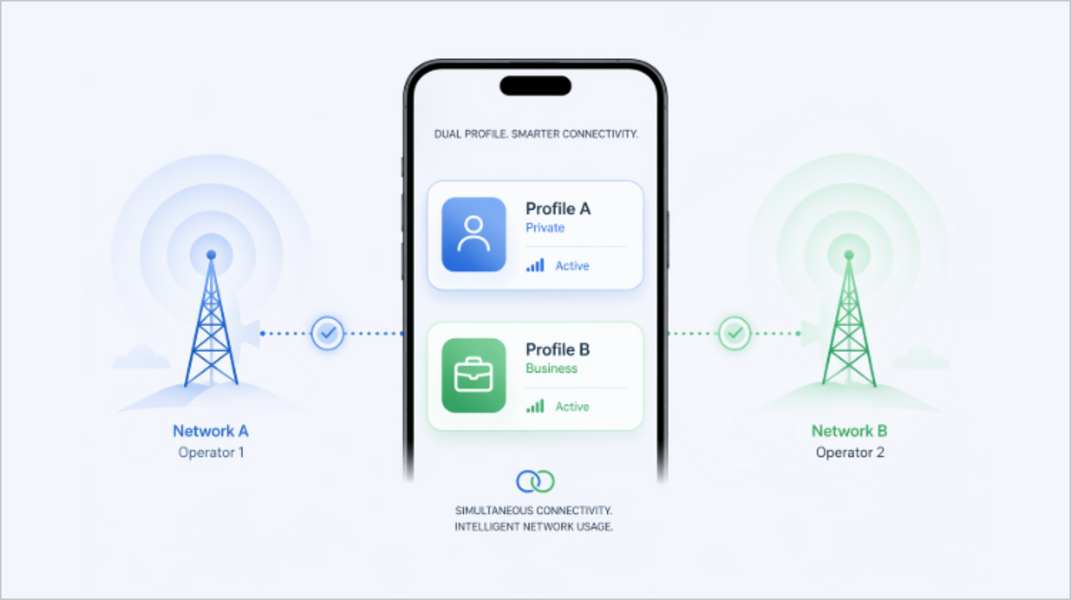
An MEP-capable eSIM in a compatible device allows two eSIM profiles to be active simultaneously. This enables a device to connect to two mobile networks in parallel – similar to dual-SIM devices, but now also for multiple eSIM profiles at the same time and without physical SIM cards.
This technical capability opens up new degrees of freedom in usage: users can precisely control which services run over which network – whether for data or for voice and SMS. What is particularly noteworthy is the level of granularity: for voice and SMS, assignments can even be made per contact or phone number.
From a standards perspective, MEP is defined in the current GSMA specification for consumer devices (SGP.22 V3.1). At the same time, its market relevance is evident in the fact that manufacturers had already implemented the feature as an enhancement in eUICCs based on specification SGP.22 V2 – even before standardization – a clear signal of market demand.
What specific value does MEP deliver – and why is the feature relevant now?
At first glance, the key use cases are not new – they already exist in the traditional dual-SIM world. What is new, however, is the fully digital and significantly more flexible implementation via eSIM – particularly when it comes to setup and switching between profiles.
At its core, three central application scenarios can be identified:
- Using a single device for both personal and business purposes
Two profiles on one device enable clear organizational separation without the need for additional hardware.
- Targeted cost optimization
Users can combine different plans – for example, pairing an optimal data plan with a separate plan for voice and SMS.
- Optimized connectivity while traveling
Users remain reachable via their familiar phone number and continue to use voice and SMS via roaming – even if this involves higher costs. For data, however, network selection remains flexible, allowing users to choose a cost-effective local provider.
What becomes clear is that MEP is not a niche feature – it addresses everyday, economically relevant use cases, which is precisely what makes its widespread adoption likely.
What challenges exist in MEP testing?
A key challenge lies in the lack of harmonization: the industry has not agreed on a single, unified implementation. Instead, several variants exist:
- MEP-A1 and A2 (eUICC-driven multi-port model)
- MEP-B (device-driven multi-port model)
In practice, this means that test solutions must support multiple variants simultaneously.
This not only increases technical complexity but also significantly raises development and validation efforts. MEP thus becomes a classic example of how the pace of innovation and standardization do not always progress in sync.
How is MEP tested – and what role does conformance testing play?
Since MEP was only officially introduced with the GSMA eSIM specification SGP.22 V3, standardized conformance testing exists only for Phase 3 of the spec. In the previous version, SGP.22 V2, MEP is not yet an official feature of the specification and is therefore not covered by conformance tests.
Testing of MEP functionality takes place on multiple levels and includes both standardized and non-standardized testing approaches.
- eUICC (Conformance Testing)
At the eUICC level, it is ensured that MEP is implemented in accordance with the GSMA eSIM specification SGP.22 V3.1 and the associated test specification SGP.23-1.
Conformance testing in this area is covered by GlobalPlatform. Validated test solutions are already available here, which also take different MEP variants into account.
- Device (Conformance Testing)
At the device level, the focus is also on specification compliance according to GSMA SGP.22 V3.1 and the test specification SGP.23-2. Conformance testing is performed in accordance with PTCRB (USA) and GCF (international) certification frameworks.
A first test solution is already available in this area. However, for it to become mandatory within GCF and PTCRB certification for devices with GSMA SGP.22 V3.1 eSIM support, it must first be validated. This validation requires devices that support the relevant standard – these are not yet available. COMPRION is already working with an initial manufacturer to enable this step as quickly as possible.
- End-to-End (non-standardized)
The real complexity emerges in the interaction of components during actual operation. This level is not only about specification compliance, but about real-world behavior in a usage context. Typical questions include:
• How do services behave when a second profile is added?
• Are data, voice, and SMS correctly routed according to user settings?
• What happens when a profile is deactivated?
• How are previously assigned services handled afterward?
There is no standardized test specification for this level. Responsibility therefore lies with device manufacturers and mobile network operators to cover these aspects independently.
How can MEP already be tested during development?
In addition to classic conformance tests, development-accompanying test tools are becoming increasingly important. They make it possible to analyze and validate MEP functionality at early stages of development, particularly with regard to:
- the management of multiple activated eSIM profiles
- the interaction of simultaneously active profiles within a device
This shifts part of the validation significantly earlier in the development process – an important aspect given the increasing complexity of modern eSIM functionalities such as MEP.
One example is the COMPRION eUICC Profile Manager, which has been extended to support MEP.
Who is MEP testing particularly relevant for?
MEP is a feature where it is not enough for individual technical functions of eSIMs and devices to work correctly according to the GSMA specification. What matters most is the interaction between multiple eSIM profiles, different mobile networks from various MNOs, and the device that determines which profile is used for which service.
It is precisely this system complexity that makes MEP testing especially relevant for mobile network operators (MNOs). From the user’s perspective, the quality of the connection is ultimately experienced where it becomes visible – at the network provider level.
Typical critical scenarios arise exactly at this interface:
- services do not function reliably
- communication or traffic is routed over the wrong network
- unexpectedly high costs occur
The implication is clear:
MEP is evolving not only into a technical feature, but also into a quality and differentiation factor in the customer experience – and therefore into a strategically relevant topic for MNOs.
Where is MEP heading – and what new use cases are emerging?
MEP opens up the long-term possibility of much more granular control over which data is transmitted via which network and which active profile. This control could, for example, be based on QoS metrics in the future to ensure an optimized user experience.
In addition, new application scenarios are emerging in the context of private and campus networks. In such setups, internet traffic could continue to run over public mobile networks, while security-critical or enterprise-specific applications such as VPN connections are deliberately routed through private networks.
The automotive sector is also creating new opportunities: here, certain services – such as paid navigation services – could be handled via the vehicle manufacturer’s network or profile, while other applications like music streaming run through the driver’s profile.
Another development path is the potential extension of MEP in the context of the GSMA eSIM specification for IoT devices (SGP.32). In this area, MEP could be used particularly for redundancy scenarios, dynamically steering traffic depending on network availability and QoS – an important aspect for mission-critical use cases with high connectivity requirements.
Related News
![]()
COMPRION enhances the eUICC Profile Manager with Multiple Enabled Profiles (MEP) support based on GSMA SGP.22 v3, enabling simultaneous eSIM profiles,…
Read more
![]()
COMPRION releases new GSMA SGP.23-2 tests for validating MEP (Multiple Enabled Profiles), enabling simultaneous eSIM profiles and supporting early…
Read more
![A photorealistic image of a modern smartphone with a glowing eSIM chip icon under a magnifying glass, connected to a laptop showing protocol analysis of eSIM-device communication]()
COMPRION announces the release of eSIM Tracer Release R1.1 – a significant update to the powerful diagnostic tool that visualizes real-time…
Read more